
In my final year of university, I undertook a capstone project in supramolecular chemistry under the supervision of Prof. Thorfinnur Gunnlaugsson. My work investigated the properties of a particular BTP-based ligand and studied how addition of functional groups at a key position could change its behaviour.
Supramolecular chemistry involves designing molecules with deliberately engineered interactions that allow them to self-assemble into more complex structures. Aside from being structurally interesting, supramolecular systems can be exploited for chemical sensors, functional materials such as self-healing gels or antibacterial coatings, and biomaterials for medical purposes.
BTP stands for 2,6-bis(1,2,3-triazol-4-yl)pyridine, a relatively new chemical scaffold for supramolecular and coordination chemistry. It is distinguished by:
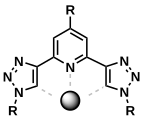
Over the last decade, the Gunnlaugsson Group has been at the forefront of BTP research for coordination chemistry, focusing on how different structures can be attached to the BTP scaffold to achieve a desired effect.
My project continued this work, functionalizing a previously studied BTP-containing ligand at the position marker “R” on the side chain. The target ligands are shown below:
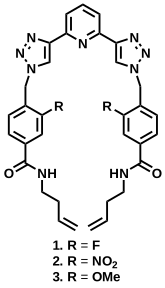
My research showed that the nitro and methoxy ligands (2 & 3) could not be synthesised through a previously used click-chemistry approach, suggesting steric or electronic disruption of the CuAAC click mechanism.
The fluoro ligand (1) was successfully synthesised and fully characterised, with the following properties recorded:
The preferred complex stoichiometry is 1:3 (metal:ligand), matching predictions for this ligand and confirming no reduction in coordination ability by the added functional group.
The ligand showed a slightly higher affinity for Eu(III) and Tb(III) ions than the unsubstituted ligand, indicating that the substitution does not sterically hinder metal coordination as originally hypothesised.
Coordination studies under kinetic conditions showed an unusual reduction in coordination with Tb(III) compared to the same ligand with Eu(III), and compared to the unsubstituted ligand. The source of this difference is not yet understood.
The ligand successfully undergoes a ring-closing reaction with Grubbs’ catalyst, forming a [2]catenane. The fluorine functional group does not disrupt the self-templated assembly process.